Byzantine Empire: A History From Beginning to End by Hourly History
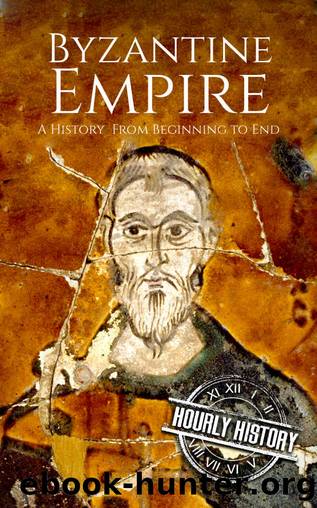
Author:Hourly History [History, Hourly]
Language: eng
Format: epub
Publisher: Hourly History
Published: 2018-01-02T00:00:00+00:00
Chapter Five
The Destruction of Icons
âBy the most obvious of objective measures, the disasters of the seventh and eighth centuries greatly impoverished Byzantine culture. Unless every available indicator is misleading, fewer authors wrote, fewer teachers taught, fewer artists and artisans created, and fewer builders built.â
âWarren Treadgold
At this perilous moment, a new emperor took power. Leo III was a Syrian and a military commander, and he had a plan to deal with the oncoming Arab invasion. He attacked the navy with Greek Fire, and by allying the Byzantines with the Bulgars, he was able to stave off the Arabs on land as well. An exceptionally cold winter worked in Leoâs favor, and the Arab army outside Constantinople suffered. When the caliph sent reinforcements in the spring of 718, he made the mistake of manning his ships with sailors mainly from Egypt and Africa, places where Christianity was the primary religion. These Christian crews turned against the caliph and supported Emperor Leo. The Arabs left by summer, and Constantinople was saved.
However, much of the empire lay in shambles, and many of the highly religious Byzantines reasoned that they must have incurred the anger of God. Leo, searching for a cause for this supposed divine wrath, settled his attention on icons. Icons were images designed to aid in worship, but some thought that this had gone were too farâthat people had begun to worship the images themselves. The proliferation of these religious images certainly contrasted the policies of the successful Muslims, who rejected all religious imagery. Leo began his iconoclastâimage destroyingâcampaign with the demolition of a mosaic of Christ on a palace gate. The action set off a riot in the city, but Leo, convinced of his position, continued to escalate his attempts to eradicate icons. This crusade brought the emperor into direct conflict with the pope. Leo responded by denying the authority of the papacy in the east and confiscating papal holdings. At Leoâs command, thousands of icons were destroyed across the remainder of the empire, though many were hidden from the emperorâs wrath and survived. Though many Byzantines did not support iconoclasm, Leoâs continued victories against the invading Arabs lent him security on the throne.
Leoâs son Constantine V ascended to the throne in 741. Though initially hampered by a revolt, eventually he carried on the iconoclastic campaign his father had started. In the 760s, realizing that many individuals in religious orders opposed iconoclasm, Constantine began a widespread persecution of monks and nuns. Like his father, Constantine achieved some major victories in battle, succeeding in driving the Bulgars out of the Balkans and the Arabs from Asia Minor. However, the schism in the empire between the iconoclasts and those who supported the use of icons was deep. Beyond this, most Christians outside of the empire or on its fringes condemned iconoclasm. Many who had once believed in the divine appointment of the emperor as the worldâs Christian ruler began to question his spiritual authority, and the place of Constantinople in the greater world began to change.
Download
This site does not store any files on its server. We only index and link to content provided by other sites. Please contact the content providers to delete copyright contents if any and email us, we'll remove relevant links or contents immediately.
| Africa | Americas |
| Arctic & Antarctica | Asia |
| Australia & Oceania | Europe |
| Middle East | Russia |
| United States | World |
| Ancient Civilizations | Military |
| Historical Study & Educational Resources |
The Dawn of Everything by David Graeber & David Wengrow(1707)
The Bomber Mafia by Malcolm Gladwell(1622)
Facing the Mountain by Daniel James Brown(1553)
Submerged Prehistory by Benjamin Jonathan; & Clive Bonsall & Catriona Pickard & Anders Fischer(1455)
Wandering in Strange Lands by Morgan Jerkins(1429)
Tip Top by Bill James(1416)
Driving While Brown: Sheriff Joe Arpaio Versus the Latino Resistance by Terry Greene Sterling & Jude Joffe-Block(1376)
Red Roulette : An Insider's Story of Wealth, Power, Corruption, and Vengeance in Today's China (9781982156176) by Shum Desmond(1359)
Evil Geniuses: The Unmaking of America: A Recent History by Kurt Andersen(1352)
The Way of Fire and Ice: The Living Tradition of Norse Paganism by Ryan Smith(1336)
American Kompromat by Craig Unger(1315)
F*cking History by The Captain(1303)
It Was All a Lie by Stuart Stevens;(1300)
American Dreams by Unknown(1285)
Treasure Islands: Tax Havens and the Men who Stole the World by Nicholas Shaxson(1272)
Evil Geniuses by Kurt Andersen(1257)
White House Inc. by Dan Alexander(1212)
The First Conspiracy by Brad Meltzer & Josh Mensch(1174)
The Fifteen Biggest Lies about the Economy: And Everything Else the Right Doesn't Want You to Know about Taxes, Jobs, and Corporate America by Joshua Holland(1126)
